
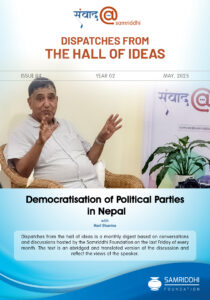
The health of a democracy depends not only on elections and constitutional arrangements but also on the internal functioning of the institutions that mediate political participation. In Nepal, political parties have historically played a central role in advancing social and political transformation. Yet growing concerns about accountability, patronage, declining internal deliberation, and weak connections between leaders and citizens have prompted renewed debate about the quality of democratic practice beyond formal procedures.
Reflecting on Nepal’s political evolution, Mr. Hari Sharma considers the relationship between party structures, citizen engagement, and democratic legitimacy. He emphasizes that strengthening democracy requires more than periodic elections—it demands active public participation, meaningful dialogue, and political organizations capable of representing collective interests rather than narrower networks of influence.
The text is an abridged and translated version of the May 2025 edition of Sambaad @ Samriddhi. Sambaad @ Samriddhi is a monthly discussion on contemporary issues held on the last Friday of each month. In this edition, Political analyst Hari Sharma shares his insights on Democratisation of Political Parties in Nepal. The discussion was moderated by Deependra Chaulagain.