
by – Niyati Shrestha
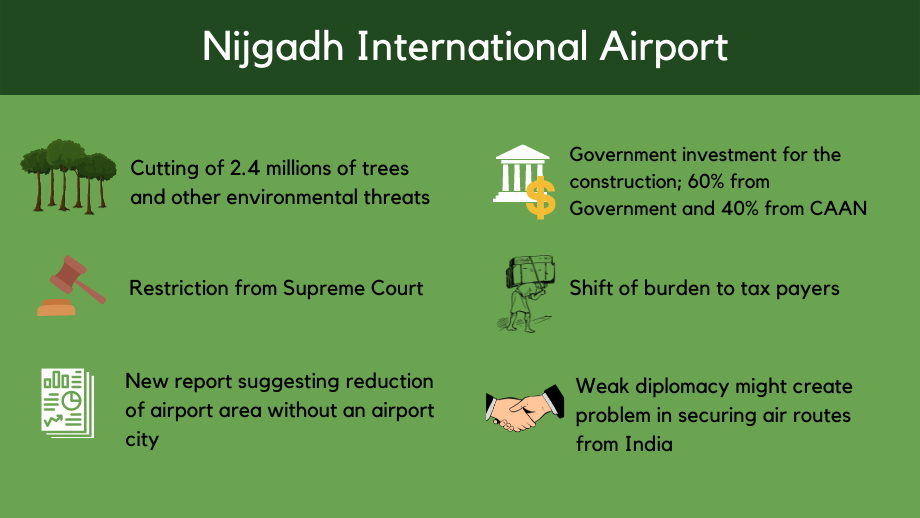
The dangling fate of the national pride project, Nijgadh International Airport (NIA) came to a rest when the Supreme Court halted the ongoing project recently on May 26 2022. The court gave an order to look out for an appropriate alternative in order to build the international airport following the country’s law. While every successive government pressed on the need for an alternative to Tribhuvan International Airport, environmentalists resisted the construction highlighting the huge damage to the environment. The falling of around 2.4 million of trees in the dense forest corridor for big wildlife like tigers and elephants and home to diverse plant species had raised the alarm of the environmental crisis and the controversial EIA report had raised suspicion against the government. Based on these, a writ was filed against the government by senior advocate Prakash Mani Sharma and Ranju Hajur Pandey and the court’s verdict was in their favor. However, this still leaves us with a big question if the environmental crisis is the only concern associated with the construction of Nijgadh International Airport?
Following the decision of the Supreme Court, the government had formed a panel of experts to further study the prospects of the airport. The report presented by the panel of experts concluded that the full-fledged NIA is the current need for the country to control growing air traffic congestion and cater the arrival of a large number of tourists which is in increasing trend. The report has even proposed a suitable location of about 4000 hectares for the airport. In an effort to minimize deforestation and environmental damages, the committee reduced the airport area from 8000 hectares to 4000 hectares and even scrapped the idea of constructing an airport city. Such efforts seem that the government is dedicated to completing the national pride project.
However, one of the problems still persisting is the allocation of budget for such a massive project. In the case of Nijgadh it has been decided that the project would be carried along with the investment from the Government. The Director General of Civil Aviation Authority of Nepal (CAAN), Engineer Pradeep Adhikari has stated that the sixty percent of the investment would be covered by the Government and the remaining forty percent by the CAAN. It is clear that the burden of such a massive undertaking will shift to the general public just like in the case of the Budhi Gandaki Hydropower Project that will eventually delay the implementation of the project. Adding to this, other administrative and procedural hindrances along with divided interest of political parties are enough to question if the government will successfully complete the construction of the airport which is divided into three different phases.
Moreover, construction of an infrastructure does not ensure the full operation of the airport. The fine example for this is the Gautam Buddha International Airport which came into operation in mid May 2022. The airport has not been able to operate in its full capacity as Jazeera Airlines is the only international airline using the airport and Nepal has not been able to secure an alternative air route from the west of the country from the Indian Government. If something similar happens with NIA, if Nepal fails to secure air routes from different countries then the goal of making it an air hub will not be successful and all the hopes of enhancing Nepal’s connectivity and accelerating economic growth will crash down. On top of that the massive investment which is basically hard earned money of the general public will go into vain.
A well facilitated airport is definitely a need for Nepal as the number of air passengers have been massively increasing every year. But in case the government fails to execute its plan properly then the future of NIA is going to be similar to that of Mattala Rajapaksa International Airport in Sri Lanka which was once envisioned to become a prestigious airport city but now instead of airlines and passengers, animals like elephants roam in the airport. If anything as such is to happen in case of NIA, then the trees which are of huge concern at the moment might grow back in the abandoned airport but it’s our resources and time that is going to be spent which cannot be reimbursed. Thus, in order to avoid such mishap the Government of Nepal should be very careful estimating the returns on investment before starting the project and if it is determined to carry out its plan then it must be executed to complete the project on time.