
Introduction
Nepal’s economy remains plagued by low investment and limited employment opportunities. In 2021, the labour force participation rate stood at just 39%, while 34.8% of youths aged 15–24 were not in education, employment, or training. Even among those who are employed, 81.8% work in the informal sector, often without job security or social protection. Despite excess liquidity in banks and financial institutions, demand for investable funds has remained weak, largely due to a hostile investment environment. Nepal Rastra Bank has repeatedly absorbed liquidity from the financial system, with more than NPR 400 billion previously mopped up yet to mature. This reflects a deeper structural problem: capital exists, but confidence to invest does not.
Against this backdrop, Samriddhi Foundation is conducting an evidence-based policy paper focused on key economic and market-oriented reforms necessary for sustainable economic upliftment through improved governance, investment-friendly rules, and employment generation. The central premise of this initiative is that stronger markets and institutional reforms are essential to generate jobs, enable entrepreneurship, and create long-term opportunities for young people.
Young Nepalis are increasingly discontented with the current economic situation. Many see little hope for their future. To address this, the study will seek to understand how young people are doing business in Nepal and identify the legal, regulatory, and operational barriers they face. The proposed paper will draw on both primary research and secondary data and will be accompanied by a public launch and policy dialogue aimed at identifying and debating priority reforms.
Samriddhi Foundation will conduct extensive consultations with young entrepreneurs under the age of 40 to document key challenges facing youth-led businesses. Follow-up surveys will be administered to a subset of participants to gather deeper insights. In parallel, the study will review international experiences and reform models that have successfully addressed similar challenges. Based on these consultations and comparative analysis, the paper will develop an actionable reform agenda to promote young and innovative entrepreneurs, positioning them as pillars of growth, job creation, and long-term economic resilience in Nepal. By transforming Gen Z frustration into constructive policy solutions, this initiative seeks to move Nepal from protest toward progress.
More specifically the project has the following objectives:
- Identify key legal, regulatory, and institutional barriers faced by young entrepreneurs in Nepal.
- Assess how governance and market conditions affect investment and job creation.
- Draw lessons from international reform experiences relevant to Nepal’s context.
- Develop a practical, evidence-based reform agenda focused on youth entrepreneurship and employment generation.
- Facilitate policy dialogue among government, private sector, civil society, and youth leaders.
Methodology
1. Primary Research
- Consultations with young entrepreneurs (under 40):
In-depth interviews and roundtables across key sectors and regions to identify operational, regulatory, and financial constraints. - Follow-up surveys:
Quantitative and qualitative survey of a subset of consulted entrepreneurs to validate trends and prioritize reform areas.
2. Secondary Research
- Review of Nepal’s investment climate, labour market data, and regulatory frameworks.
- Comparative analysis of reforms implemented in peer countries to address similar challenges.
3. Policy Paper
- Synthesis of findings into a concise, actionable policy paper.
- Preparation of reform recommendations targeting governance, investment facilitation, business regulation, and youth entrepreneurship.
4. Dissemination and Engagement
- Public launch of the paper.
- Policy roundtable with government officials, private sector leaders, development partners, and youth representatives.
- Digital and social media outreach.
Positions
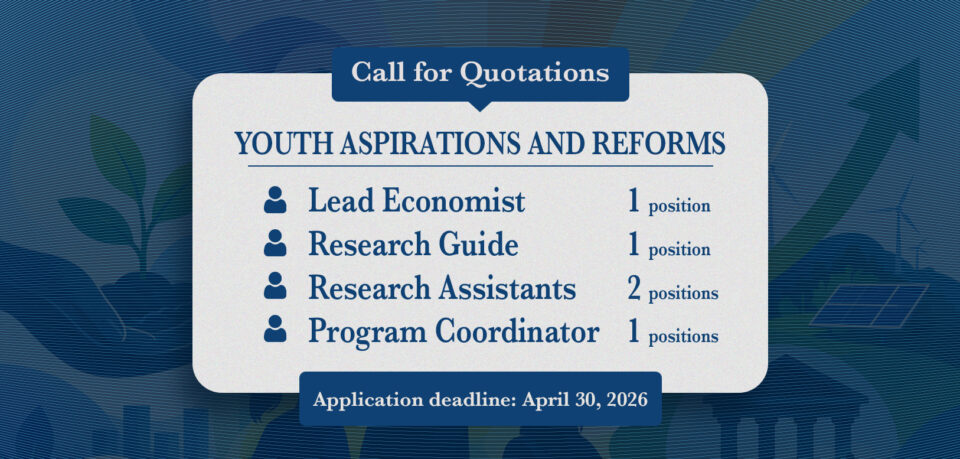
The Lead Economist will be responsible for
- Designing the study with the help of Research Guide,
- Designing Qualitative Data Collection questionnaire
- Train and supervise the enumerators for the survey
- Guide the report writing team
- Data analysis and report writing
- Attend meetings with Samriddhi Foundation team
The Lead Economist consultant should have the following qualifications:
- Have a Master’s degree or higher in Social Science (preferably economics),
- Have at least 5 years’ experience in conducting policy research,
- Have an understanding of policy reform and it’s dynamics in Nepal.
Preference will be given to candidates who have conducted studies and research related to business regulations.
Duration: The Lead Economist will work on this project for 21 man days.
The Research Guide will be responsible for:
- Design, modify and finalize questionnaire to be used for the consultations and qualitative & quantitative survey,
- Design curriculum for training of enumerators and oversee training of enumerators,
- Monitor data collected to ensure collected data meets the standards,
- Analyze and prepare the final report detailing out the results of the survey,
- Data analysis and report writing
- Other responsibilities as may be mutually agreed upon during the course of assignment.
Candidates applying for the Research Guide should have the following qualifications:
- Have a Master’s Degree or higher in Social Sciences, and,
- Have at least 5 years of work experience in analyzing and advising business policies in Nepal.
Duration: The Research Guide will work for 18 man days.
The Research Assistants will be responsible for:
- Data Analysis and Report Writing under the guidance and supervision of Lead Economist and Research Guide
- Present research finding to stakeholders in relevant meetings and forums.
Candidates applying for Research Assistant position should have the following qualifications:
- Have a Bachelor’s degree or higher in Social Sciences (preferably economics), and,
- Demonstrate an understanding of business regulatory environment and policy regime of Nepal.
Preference will be given to candidates who have worked in business research in other projects.
Duration: The Research Assistants will work for 28 man days for each consultant.
The Program Coordinator will be responsible for:
- Liaison the meetings between the researchers and relevant stakeholders for the qualitative data collection.
- Identify, meet and invite key stakeholders to the report release event along with other advocacy forums.
Candidates applying for Program Coordinator position should have the following qualifications:
- Have a Master’s degree or higher in Social Sciences (preferably Political Science), and,
- Demonstrate an understanding of business regulatory environment and policy regime of Nepal.
Preference will be given to candidates who have worked in policy advocacy in other projects.
Duration: The Program Coordinator will work for 22 man days.
About Samriddhi
Samriddhi Foundation is an independent public policy think tank based in Kathmandu that works in economic policy reform in Nepal. Samriddhi envisions a free and prosperous Nepal and works on identifying key hurdles to economic growth of Nepal along with restraints that are detrimental to fostering entrepreneurship in Nepal. www.samriddhi.org
Submission Requirements
In order to deliver this project, Samriddhi invites quotations from interested consultants for the following tasks and responsibilities. Interested individuals or consulting agencies are requested to send in detailed quotations including estimated costs, and detailed resumes to:
Either [email protected] via email, or,
hand deliver the quotation to Samriddhi premises at 664, Bhimsengola Marga, Minbhawan Kharibot, Kathmandu, Nepal.
Kindly mark the position that is being applied for on the cover of the envelope. The quotations should reach Samriddhi by 30th April, 2026, no later than 5.00 PM Nepal Standard Time. Contract award will be communicated by 15th May, 2026 to all the applicants.