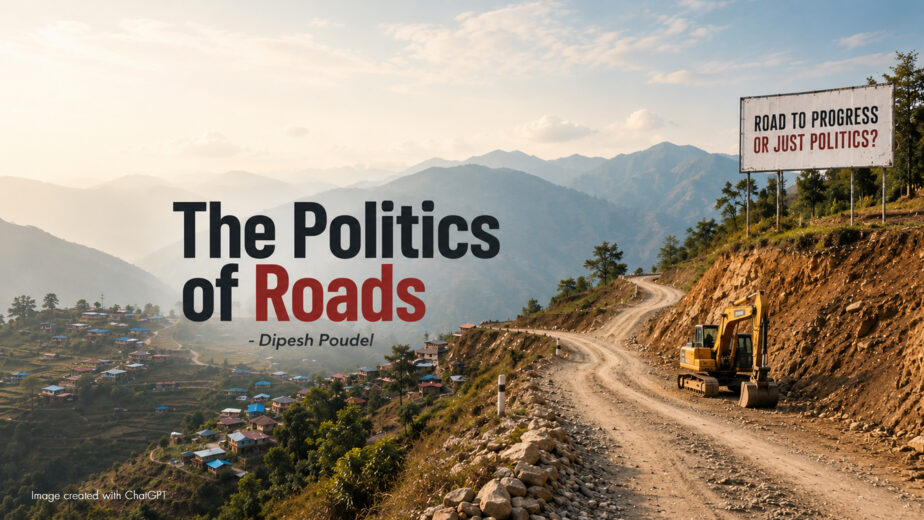
Are roads really worth all that they cost? Travel anywhere outside the Kathmandu Valley, and you will see a new dirt track cut into a hillside, a gravel road climbing toward a village that had none before. Ask a local about it, and they will point at the road with something close to pride, saying, “This government built it,” “They did something for us.” It is an easy story to believe, and for a long time nobody had much reason to question it. But what benefits accrue from the construction of a road?
A paper published in the Asian Development Review by Santosh Adhikari, Manasa Koirala, and Niraj Poudyal tries to answer the same question: after a road arrived, did people’s lives actually get better? Instead of assuming that a new road helps a village, the authors followed thousands of households across Nepal over several years to answer that question. The answer, again and again, is no or at least not in any way that it can be clearly measured. The value of people’s land did not rise. Farmers were not producing more crops or earning more from their fields. Families were not making more money from small businesses or livestock. Whether the researchers looked at paved roads or plain dirt roads, whether they looked at richer areas or poorer ones, the story stayed the same: the road showed up, but the expected benefits mostly did not in hilly regions.
What did show up, in some cases, was the opposite of a benefit. In the same hill areas, wards that had gotten new dirt roads between 2016 and 2018 also saw a clear rise in landslides. Paved roads did not carry this same risk, which makes sense once you think about how each is built: paving an existing road disturbs the hillside very little, while cutting a brand-new dirt road into a steep slope means digging out and loosening a lot of earth that used to hold the hill together. Putting these two facts together, the evidence suggests that the roads are not benefiting households, and certain types of roads could possibly impose negative externalities.
Earlier research based on data from the 1990s and 2000s showed that access to roads benefitted the household. So, What Changed? The answer lies in who is left in the emptying village to use them. Back then, rural Nepal was full of people, and farming was still how most families made their living, so a new road genuinely brought the market closer to the farm. Today, that world has changed. People have been leaving the hills for Kathmandu and for jobs abroad for years. But as the latest census shows, population has actually fallen in nearly 150 of Nepal’s 400 local wards. Farming now matters less to most rural households than the money sent home by a family member working elsewhere. Building a road in a place that is emptying will not yield the same results as in a place with an increasing population. New roads have gone precisely to the villages losing people. That is not merely unfortunate. Local leaders want to be seen delivering, regardless of whether the people and the market are still there to make it worthwhile. While the demographic story explains why these roads do not pay off, it does not explain why they keep getting built.
So, if economics no longer justifies this road construction, why do they keep getting built? The answer lies in politics. The Survey of the Nepali People has asked Nepalis, year after year since 2017, what makes them feel their country or their local area is moving in the right direction. In every single round of that survey, “better roads” comes out on top, ahead of electricity, education, and health care. In 2018, better roads was the leading reason for national optimism; by 2020, nearly three in four optimistic respondents pointed to roads as the reason; in 2022, roads still led the list at the local level, cited by well over half of those who felt their area was improving. The same survey shows that when Nepalis are asked to name a service their local government actually provides, a majority recognise roads as the infrastructure service. Public spending priorities signal in the same direction. When asked what local government should spend money on first, roads consistently appeared in top priorities, prioritised by 36.5% of respondents in 2018, 28.0% in 2020, and 31.3% in 2022.
A more recent nationwide opinion poll, conducted by Sharecast Initiative Nepal across 196 municipalities in 52 districts, shows the same pattern still persists. When asked how satisfied they are with the condition of roads in their community, 53.2 percent of respondents said they were satisfied, a majority verdict in favour of roads even now. When the same poll asked people to name the biggest problems in their own lives, “lack of quality roads” still made the list for more than a quarter of respondents, right behind unemployment and poverty. Roads are both the thing a majority of Nepalis credit the government for delivering and the thing that people say is still missing. Either way, roads remain the indicator on which local governments earn approval.
This provides a clear incentive to politicians. If you are an elected representative in a rural municipality, a road may be one of the more visible and readily recognised things you can deliver. The same survey shows that a meaningful share of Nepalis, close to a quarter in the most recent round, say they voted for a candidate specifically because that candidate would “bring development and provide services” to their area. Roads could plausibly be a fast, low-cost way to make the promise visible before the next election, whether the road actually has provided greater benefit or not. Building roads might look like a sensible choice for politicians.
So, are roads really worth the cost? Economically, at least, there is no justification for it. But when they are a cause for optimism, they will keep getting built. An economist might say the money is better spent elsewhere; a political economist would say that misses the point: the roads are not being built because they make economic sense, but because they make political sense.