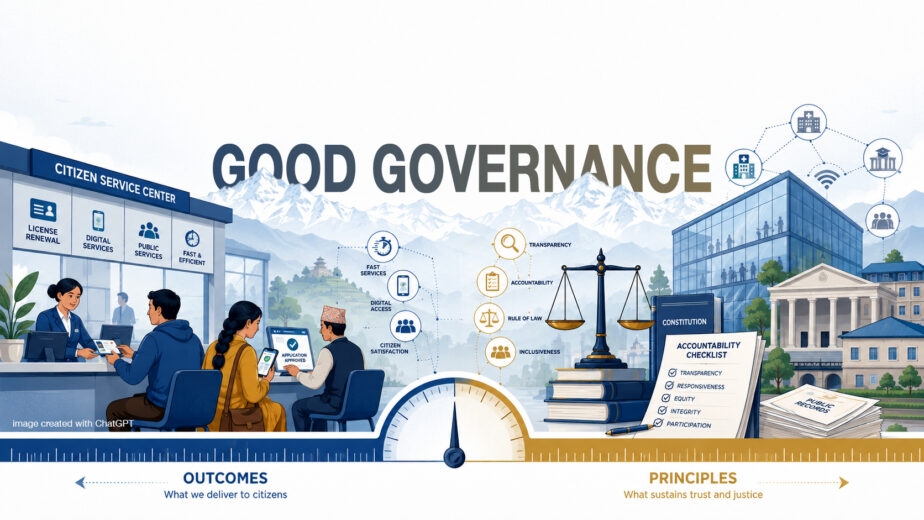
I wear two hats, that of a citizen and that of a researcher. The recent buzz about good governance has made me ponder what it really means. As a citizen, I would argue that good governance means the efficient provision of the government’s promised services. I would even argue that others like me equate straightforward, timely licence renewal, financially burden-free medical care, and clear guidance through procedures at government offices for business-related queries, among many others, with good governance. But the researcher’s perspective recognises these as outcomes of good governance. It knows instead that it is actually the government’s commitment towards certain principles—rule of law, transparency, and accountability—that would result in the aforementioned outcomes. This presents a dilemma of measuring something that remains vague to most Nepalis, yet is still widely used in Nepal’s governance and politics.
Regardless of the dilemma I am faced with, a quick survey of Government actions confirms that governance has always been at the centre. Some of the major efforts towards instilling good governance in Nepal go back to the Administrative Reform Commissions set up between 1952 A.D. and 1992 A.D. Even after the Maoist revolution, efforts to promote transparency and accountability were institutionalised through the introduction of the Good Governance Act (2008). This Act required civil servants to maintain transparency and accountability to make Nepal’s bureaucracy efficient and responsive to the public.
In fact, it is the Good Governance Act that lays bare the dual nature of good governance. The preamble of the act is structured such that it hints at both outcomes i.e. efficient public service delivery, while also committing to principles of accountability and the rule of law. In the decades since the act came into existence, outcome measures that a common citizen looks for i.e. incidence of bribery, show that the commitment has only existed on paper. Nepal’s poor ranking of 110th out of 180 countries in Transparency International’s 2022 Corruption Perceptions Index indicates that the intended outcomes might not be fully achieved. Indeed, the intense expansion of the Nagarik app may very well remove the opportunity for bribery. I am genuinely happy as a citizen, but my researcher hat reminds me that merely digitising a service is not evidence of transparency and accountability.
This mismatch between what is on paper and what ends up happening is found amongst the very institutions set up to safeguard the principles of good governance. Nepal’s anti-corruption institution, the Commission for the Investigation of Abuse of Authority (CIAA), was criticised for allowing political appointments. This pattern of political appointments eventually led to the annulment of the appointment of the 2013 CIAA chief commissioner in 2017 as he lacked required experience and moral standing. So, an institution set up to protect good governance from discretionary power and conflict of interest ended up harbouring both.
Given this, the current government has also outlined its own roadmap for achieving good governance in Nepal. It has described its first year in office as the “Year of Good Governance,” with an emphasis on reducing corruption and irregularities while improving accountability and public service delivery. It even released a roadmap comprising 100 action items with deadlines ranging from a day to 1,000 days. The government announced an 87.2% progress rate after fully completing 70 of the 100 commitments. But completing action items is itself just another outcome metric, not evidence that the underlying principles it’s meant to serve (curbing state capture, reducing policy uncertainty, insulating institutions from corruption) have actually taken hold. The process of good governance is less visible in the number of action items completed and more in if a bureaucrat’s discretionary power has been narrowed or if conflicts of interest have been managed. A government can complete 70 tasks and still leave the incentives for capture untouched.
The distinction between what is measured and how it is measured is an important one. Outcome-only measurement is gameable in a way that commitment measurement is not. A government under pressure to show results can accelerate service delivery, digitise a form, or clear a backlog without touching the deeper incentives that produced the backlog in the first place. How are we to confirm if a bureaucrat is incentivised by the principles of good governance or by the fear of consequences when they comply with the requirement of completing a task? It is very likely, if progress was driven by fear, that the pressure will fade after the deadline, resulting in the unresolved conflicts of interest and discretionary power resurfacing.
None of this is to say that outcome measurements are not necessary. Passport times have already gone down, and it is a welcome change. The more useful question today isn’t whether service delivery times have gone down, but whether in accordance with the Good Governance Act itself, there is a commitment to sound principles that has resulted in the outcomes that we are too quick to share.
Nepal doesn’t need to abandon outcome tracking; quick passports and easy licence renewals matter to people’s lives and are worth celebrating. But if the national conversation stops at “did the 100-day agenda hit its targets,” it will keep treating the symptom while the disease keeps spreading. The more useful shift is to build and publish a small, honest set of process indicators alongside the outcome ones, so that “how do we recognise good governance” has an answer that isn’t just another year of watching outcomes and hoping the commitment behind them is real.