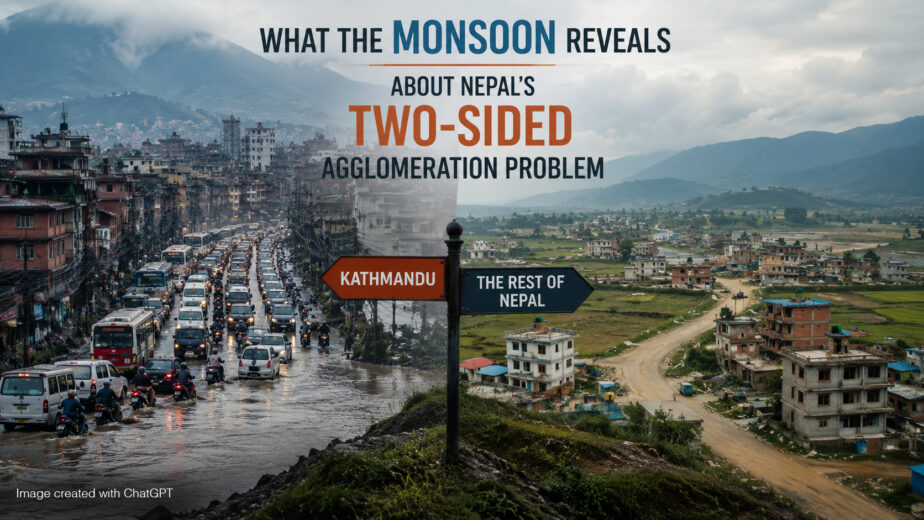
Every monsoon, the Kathmandu Valley becomes a smaller, less functional city: roads turn into channels, traffic comes to a halt, shops close, and water enters homes and businesses. This year was no different. Although the Valley experienced its usual bouts of flooding and disruption, the scale of the challenge was most vividly demonstrated in September 2024, when eleven monitoring stations inside the Valley set new 24-hour rainfall records. The rain was exceptional, but the breakdown was familiar. The September 2024 floods and landslides caused an estimated NPR 46.68 billion in loss and damage across Nepal. Many in the aftermath noted that floods in the Kathmandu Valley were the result of rapid and unplanned urbanisation. Indeed, they are correct, but it is not the full picture. Floods in the valley also reveal that Nepal does not have enough cities.
Cities are normally engines of growth because concentration creates a productive cycle. Firms locate near workers, suppliers, customers and finance; workers move towards larger labour markets; and the resulting business activity raises land values and public revenue. A capable local government can then reinvest part of that revenue in roads, drainage, markets, water and other public goods. Better infrastructure raises productivity and attracts further investment. This is the promise of agglomeration: concentration creates wealth, and part of that wealth is used to make concentration function better.
In Nepal’s case, concentration has been limited to Kathmandu and its periphery. Kathmandu’s concentration is also not simply the result of recent migration; it is historically path-dependent. Over decades, ministries, regulators, universities, hospitals, banks and corporate offices accumulated in the Valley, attracting firms and skilled workers and reinforcing further investment. The National Urban Development Strategy estimated that Kathmandu Valley produced about 31 percent of Nepal’s GDP while containing roughly 10 percent of the population and only 0.5 percent of the country’s land. It also held 60 percent of bank deposits and 44 percent of credit. This concentration continues to draw people because Kathmandu offers an opportunity premium that extends beyond wages. Although the Nepal Labour Force Survey does not isolate a Kathmandu-specific wage premium, it found an employment-to-population ratio of 36.9 percent in urban areas compared with 29.3 percent in rural areas. For many households, moving to Kathmandu therefore means not only a better chance of employment, but also access to multiple employers, national institutions, higher education and specialised health services that remain difficult to obtain elsewhere.
The problem is that Kathmandu has not converted the value of this concentration into infrastructure at the same pace. Buildings and roads have covered fields, ponds and open surfaces that once absorbed rain, while development has narrowed river corridors and seasonal waterways. Nepali Times reported that the 2018 Hanumante flood entered around 500 houses, more than 100 shops and 28 small industries, even though heavier rainfall had occurred before the area was extensively built up. The monsoon supplies the water, but poorly managed urban expansion determines how damaging it becomes. Flooding is therefore one visible cost of agglomeration growing faster than drainage, land-use control and metropolitan coordination.
On the flip side, the history of centralisation also means that local governments outside of Kathmandu are stuck in a self-reinforcing trap. For decades, Nepal’s centralised state concentrated public investment, administrative institutions, higher education, healthcare, and formal employment in the capital. Unsurprisingly, people followed these opportunities. By the time federalism created 753 local governments, many municipalities had already lost a significant share of their working-age population and economic base. A municipality needs reliable electricity, roads, water, markets, quality public services, and skilled workers before businesses are willing to invest. But providing those conditions requires revenue, technical capacity, and a sufficiently large local economy. As residents leave in search of better opportunities, the local market shrinks, businesses lose customers, and the municipality collects less revenue. With fewer resources, it struggles to improve infrastructure and public services, making it even harder to attract firms, create jobs, or persuade people to stay. The result is a self-reinforcing cycle: historical centralisation triggered outmigration, and outmigration now weakens the very capacity needed to reverse it.
Simply put, there are no cities outside of the Kathmandu valley. The Degree of Urbanisation in Nepal report classifies only 27.1 percent of the population as urban, while 39.7 percent is per-urban and 33.2 percent is rural. This is very different from the much higher share of people living inside legally designated municipalities. A municipal title does not itself create a city: productive agglomeration requires jobs, density, infrastructure and connections to a wider market. The same report shows that, once Kathmandu Valley and Pokhara are separated, the population of the remaining hill region declined by 3.7 percent between 2011 and 2021. Nepal has decentralised municipal boundaries more successfully than it has decentralised economic opportunity.
Evidence that economic opportunities have not been decentralised also comes from the GDP composition. The National Statistics Office estimates that Bagmati Province, which includes Kathmandu, will account for 36.7 percent of Nepal’s economy in 2025/26 – more than the combined shares of Gandaki, Karnali, Sudurpashchim and Lumbini provinces. The problem is further exacerbated by the limited ability of local governments to generate their own revenue. The NUDS found that municipalities generated only about 30 percent of their revenue from their own sources, while nearly 70 percent came from grants. Dependence on transfers makes it difficult to plan infrastructure whose costs and benefits extend over many years. A municipality with uncertain revenue may build an isolated road or administrative building. Still, it will struggle to create a connected system of electricity, transport, markets and serviced land capable of attracting businesses.
Some efforts have been made to bridge this gap. The Town Development Fund offers a practical bridge between local plans and long-term investment. By fiscal year 2019/20, it had completed 1,196 of 1,322 loan-and-grant projects, representing NPR 11.908 billion in investment. Its value lies not only in providing finance, but also in assessing municipal borrowing capacity, evaluating project viability and linking funding with technical support. Local governments therefore need more than formal responsibilities: they need the authority, expertise and financing to identify economic bottlenecks and structure viable investments — directly, through the Fund or with responsible private participation. When reliable electricity, water, markets or transport facilities attract firms and workers, the resulting revenue can support the next round of local infrastructure.
Yet finance alone is unlikely to solve the problem. Like most problems in Nepal, it ultimately also boils down to the big “C” word–Coordination. Nepal does not lack urban institutions. The NUDS recorded ministries, municipalities, the Kathmandu Valley Development Authority, and 262 Town Development Committees working within the urban sector. The problem was that complementary functions were divided among institutions without reliable coordination. It noted that project-level cooperation often disappeared after a project ended and that municipalities lacked the technical capacity to manage complex urban development.
Nepal therefore needs action in two directions. In the short term, Kathmandu requires coordinated management of drainage, rivers, roads, waste and land use, with local governments handling neighbourhood systems, provinces coordinating across municipal boundaries and the federal government financing infrastructure at the metropolitan scale. In the longer term, selected secondary cities and market centres must receive investment suited to their actual economic roles, rather than identical projects imposed everywhere. The aim is not to remove existing activity from Kathmandu, but to prevent every new opportunity in employment, education, health care and public investment from reinforcing the capital’s historical advantage.
The next time Kathmandu floods, rain, drains and river encroachment will rightly receive attention. But they will not explain the whole problem. Kathmandu is overwhelmed because opportunity has accumulated here faster than infrastructure and government coordination.
Because so much of Nepal’s economic and administrative activity is concentrated in Kathmandu, a flooded road there can become a national disruption. The monsoon therefore reveals a deeper two-sided problem: Kathmandu attracts more people, jobs and investment than its infrastructure can manage, while many rural and smaller municipalities lose people before they can build the markets, revenue and public services needed for growth. Kathmandu floods and rural Nepal empties because both are caught in the same dysfunctional agglomeration system.