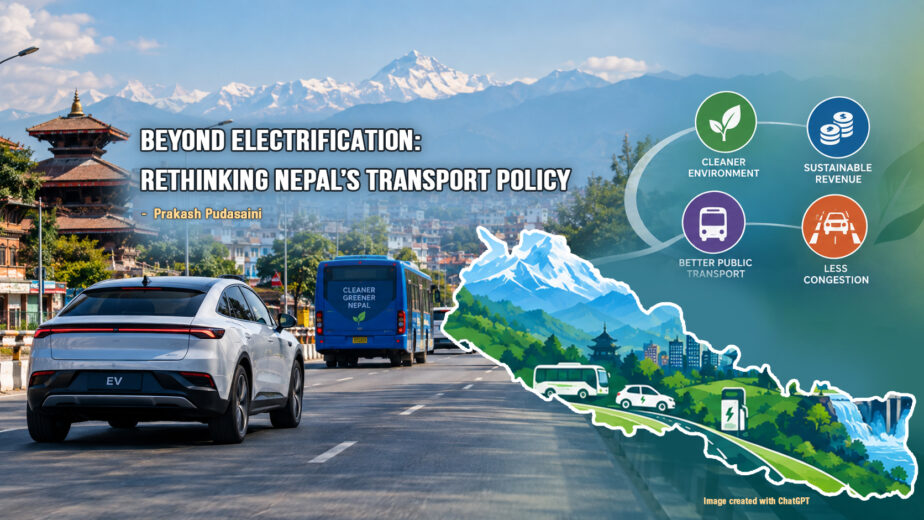
By most indicators, Nepal’s electric vehicle policy has been successful. In FY2019/20, Nepal imported 236 EVs compared with 10,310 petrol and diesel vehicles. By FY2024/25, EVs accounted for 72.9 percent of all four-wheeler imports. The share has since remained at about 73.5 percent. Fiscal incentives have supported this transition. Customs duty on EVs ranges from 15 to 80 percent, while it reaches 288 percent for petroleum cars. The World Bank estimates that duties and taxes, including VAT, represent 23 percent of the price of an EV, compared with 71 percent for an equivalent internal combustion engine (ICE) vehicle. These provisions have helped shift the vehicle market away from petroleum dependence. But the success of EV adoption also raises questions about how transport policy should address revenue, congestion and pollution.
The first concern is government revenue. The government collects substantially less tax per EV under the preferential tax structure and also forgoes future revenue from petrol and diesel consumption. One estimate suggested that annual sales of 24,000 EVs could imply about NPR 1.26 billion in forgone tax revenue. This loss, however, need not translate into an equivalent loss in overall tax revenue. Households that spend less on vehicle purchase and fuel have more disposable income, which can generate additional tax revenue through consumption and other activities. A stable tax-to-GDP ratio suggests that the decline in vehicle-related revenue has, at least in part, been offset by taxes collected elsewhere.
The more immediate challenge is that Nepal’s EV policy has changed the power source of vehicles without changing the amount of road space that vehicles require. According to Kathmandu Valley Traffic Police data, the number of vehicles on the Valley’s roads increased from 1.18 million in 2017 to 1.4 million in 2021 and 1.75 million by 2022. The department also reports that around 2 million vehicles were operating in 2026.
These figures are better understood by distinguishing between substitution and addition. If EVs replace existing petroleum vehicles, electrification changes the vehicle fleet without increasing the number of vehicles on the road. If incentives instead encourage households to purchase vehicles they would not otherwise have purchased, they add to demand for road space. The available import statistics suggest that the transportation market has expanded alongside the shift to EVs rather than EVs simply replacing combustion vehicles. An electric car still occupies road space, requires parking and contributes to congestion regardless of its power source.
More importantly, private vehicle electrification has not been accompanied by an equally strong shift towards public transport. Nepal’s Nationally Determined Contributions (NDC) climate report puts forth that Battery Electric Vehicles (BEVs) accounted for 46 percent of private four-wheeler sales in 2024, compared with 29 percent of four-wheeler public passenger vehicle sales. The Kathmandu Metropolitan City has estimated the economic loss from traffic congestion at around NPR 116 billion. EV policy should be accompanied by transport policy that manages total demand for road space through reliable electric public transport, mass transit and other measures that reduce dependence on private vehicles.
The environmental case for EVs is stronger, but it should not be framed as a transition to zero pollution. Replacing an ICE vehicle with an EV eliminates tailpipe emissions and reduces lifecycle greenhouse gas emissions. A Nepal-specific life-cycle assessment estimated emissions of 187 grams of carbon dioxide per kilometre for a battery electric vehicle, compared with about 507 grams for a similar petrol vehicle under similar baseline assumptions. The advantage becomes greater as Nepal relies more heavily on hydroelectricity.
Electrification, however, does not eliminate environmental costs. Vehicle manufacturing and battery supply chains generate emissions, while EVs continue to produce non-exhaust particulate matter from tyres, roads and brakes. This is particularly relevant in the Kathmandu Valley, where research has identified traffic as a major source of urban pollution. Vehicle-related sources accounted for 52 percent of measured black carbon, while traffic-related sources contributed 62 percent. Other research in the Valley has also identified road dust and vehicle exhaust as common sources of PM2.5 and PM10.
Indeed the fiscal policy for promoting EVs has genuine environmental benefits, but it is also important to recognise that fiscal policy is but one component of the overall environmental policy. As the number of vehicles continues to increase, Nepal may reduce exhaust emissions without proportionately reducing road dust, tyre particles, congestion-related exposure and other non-exhaust sources of urban pollution. Electrification therefore needs to be accompanied by measures that reduce unnecessary private vehicle use, improve public transport and control non-exhaust sources of pollution. Nepal’s transition to electric vehicles is, in many respects, a policy success. It has shifted the vehicle market away from petroleum dependence and can deliver substantial environmental benefits. But changing the vehicle’s power source also changes the economics of the transport system. The resulting challenges i.e., declining vehicle-related revenue, changing tax burdens, rising vehicle volumes, congestion, and persistent sources of pollution, cannot be addressed through EV policy alone.
Nepal is not the only country to face these issues. Norway’s experience shows how rapid EV adoption can eventually require governments to reconsider how transport is financed, while New Zealand’s move to road-user charges for EVs illustrates how transport financing can be redesigned as the vehicle mix changes.
The policy lesson is that electrification should be embedded within broader transport reform. That reform must account for revenue, vehicle volumes, congestion, emissions, infrastructure requirements and opportunity costs. Electric vehicles can make mobility cleaner, but whether that green mobility is also fiscally sustainable, less congested and more efficient depends on how the wider transport system is designed.