
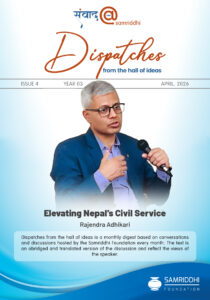
Nepal’s civil service is held back not by a lack of talent, but by a flawed system that rewards generalists, institutionalizes mistrust, and prioritizes job security over performance. Rajendra Adhikari argues that officials are routinely placed in roles unrelated to their expertise, preventing the development of specialized knowledge and weakening service delivery. The most striking insight is that Nepal’s bureaucracy operates on a culture of collective mistrust—treating both citizens and employees as inherently suspect, creating delays, inefficiency, and risk-averse behavior. The paper calls for a shift to a cadre-based system, performance-linked incentives, trust-based governance, and greater use of technology. Ultimately, meaningful reform requires a “re-engineering of the bureaucratic soul,” transforming civil servants from controllers of citizens into genuine public servants dedicated to national development.
The text is an abridged and translated version of the April 2026 edition of Sambaad @ Samriddhi. Sambaad @ Samriddhi is a monthly discussion on contemporary issues. In this edition, Rajendra Adhikari, Senior Director of Studies at Nepal Administrative Staff College, shares his insights on the civil service reform in Nepal. This discussion was moderated by Manogya Sharma.