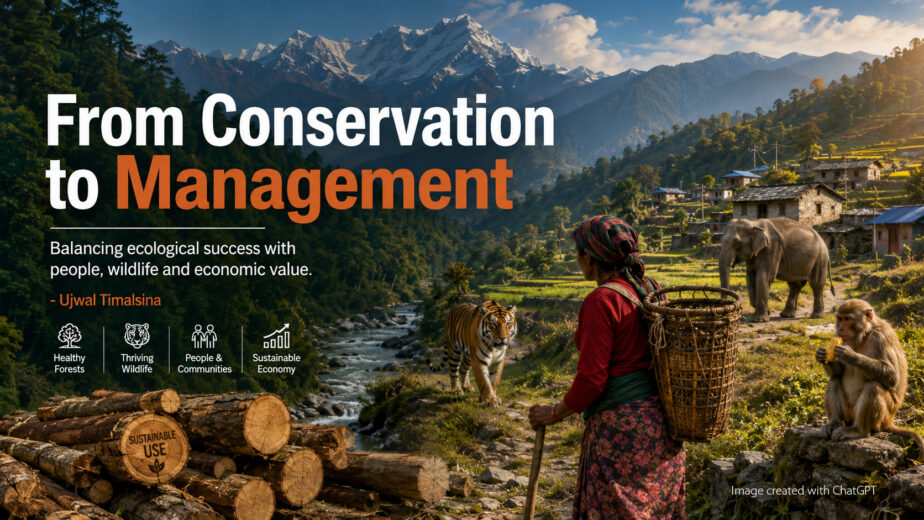
Nepal has made massive progress in conservation over the past few decades. Forest cover jumped from below 30 percent in the early 1990s to more than 45 percent today, making Nepal one of the few countries in the world to successfully reverse the trend of deforestation. Government efforts to protect forests and wildlife, crackdowns on illegal logging, and the success of community forestry all contributed to this recovery. Wildlife has rebounded alongside the forests. Nepal’s tiger population, for instance, has grown from about 121 in 2009 to 429 in the latest national tiger census. These are remarkable achievements. But as we celebrate them, a different question is beginning to emerge: what happens when conservation succeeds on this scale?
There is little doubt that forests and healthy ecosystems provide enormous benefits. They protect water sources and soil, absorb carbon and support biodiversity. In Nepal, forests also support tourism and provide fuel, fodder and other resources to millions of people living around them. The recovery of wildlife has brought its own benefits, particularly through tourism and Nepal’s growing reputation as a conservation success story. Many of these benefits are difficult to put a price on, and they are a strong reason to continue protecting Nepal’s natural environment.
But conservation also has costs, and some of those costs are becoming increasingly visible. One of the clearest examples is the growing conflict between people and wildlife. Conservationists have long recognised that protected areas have limits. Experts have previously estimated that Nepal’s tiger habitat could support roughly 400 tigers. The latest census puts the population above that figure, raising questions about what happens when wildlife populations grow beyond what their existing habitats can comfortably sustain.
There are already signs of this pressure around protected areas. Animals are increasingly being seen outside conservation areas, in buffer zones, peripheral forests and sometimes very close to human settlements. Rhinos wandering through the streets of Sauraha have become an almost charming sight. They often become viral on social media and attract tourists’ attention. Encounters with elephants, tigers and leopards are much less charming. These animals are not necessarily looking to harm people. They may be following prey, searching for food or simply moving through an increasingly crowded landscape. But when a tiger comes near livestock, an elephant enters a settlement or a leopard is spotted near a house, conflict can erupt quickly.
According to the Department of National Parks and Wildlife Conservation, wildlife attacks killed 15 people and seriously injured 48 others across Nepal in fiscal year 2025/26 alone, although this number is in decline since peaking during Covid19. Elephants and tigers were responsible for the largest share of the deaths, and most conflict happens in buffer zones. The government also paid roughly NPR 136 million in compensation for wildlife-related losses during the same year, alongside thousands of cases of livestock loss and crop damage.
Not all of these costs are as visible. In many parts of the hills, another conflict is taking place between farmers and monkeys. Troops of monkeys raid fields and villages for crops, fruits, and whatever food they can find. For households already struggling to make a living from small plots of land, repeated crop losses can become a serious economic burden. In some places, the problem has become so persistent that families have reportedly abandoned farmland altogether. Unlike a tiger attack, a monkey raid rarely makes national news. But repeated losses spread across thousands of households can be economically significant. It is another example of how the costs of conservation can accumulate quietly among the communities living closest to forests.
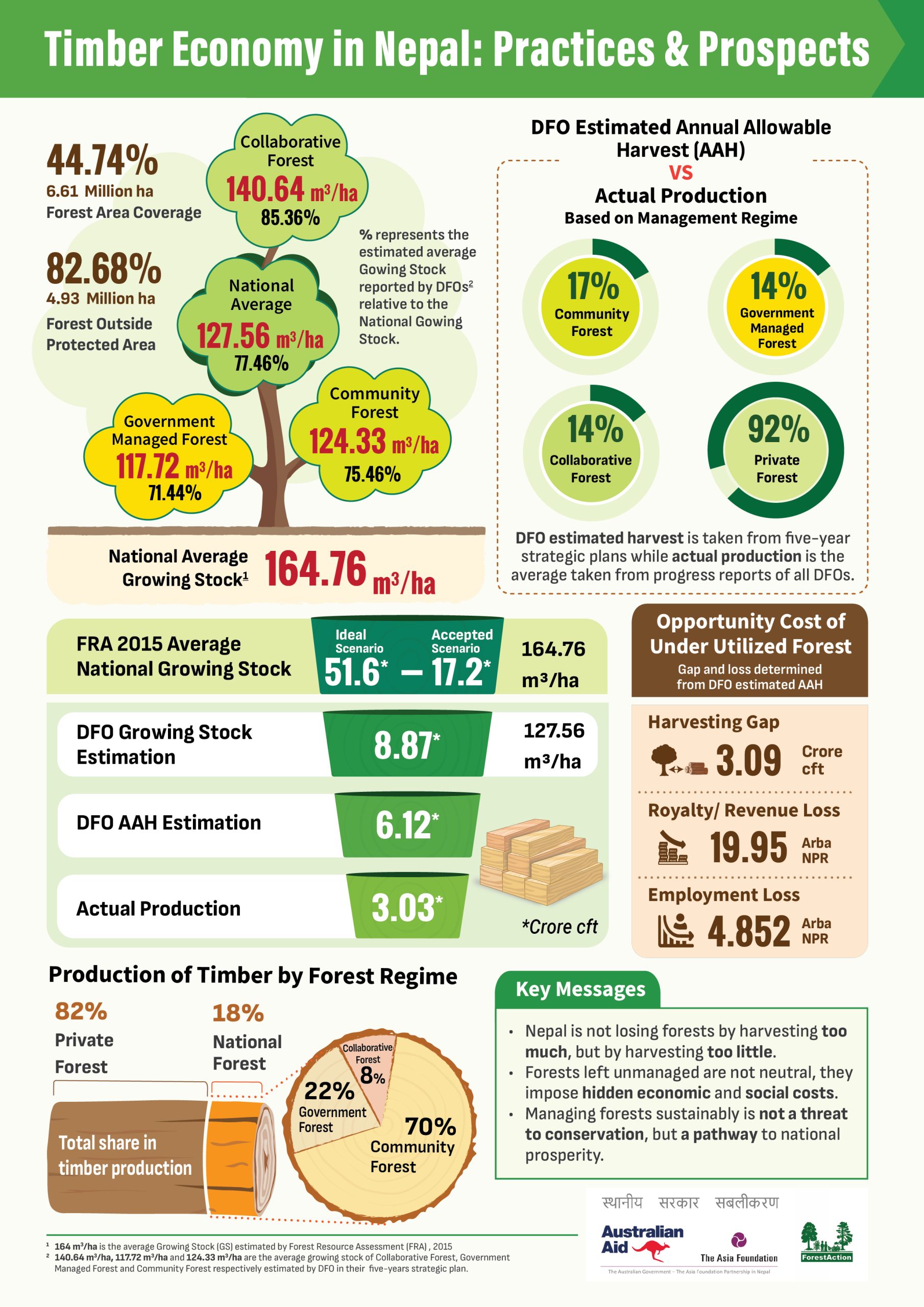
There is also a different kind of cost that has little to do with direct conflict with wildlife. Nepal’s forests are becoming an increasingly valuable economic resource, but much of that resource remains unused. In 2026, Forest Action Nepal found that the country harvests less than 17 percent of the sustainable timber yield available from its national forests, even though forests now cover more than 45 percent of the country’s land. At the same time, Nepal spends more than NPR 130 billion a year importing timber, furniture and substitutes such as aluminium and uPVC, according to recent industry estimates.
The contradiction is apparent. Nepal has spent decades restoring and protecting its forests, yet legally harvestable timber can remain unsold in the forest. Reporting by Mongabay in February 2026 found thousands of cubic metres of timber sitting unused in districts such as Bara and Nawalpur, with high government royalties and lengthy permitting processes among the factors holding back its use. If domestic timber becomes more expensive than imported alternatives, the result is not necessarily greater conservation. Sometimes it simply means that a resource that could have generated income and employment remains unused while Nepal imports the same products from elsewhere.
A tiger entering a settlement, monkeys destroying crops and timber remaining unused in a forest may not look like the same problem but they point towards a common question. The benefits of conservation are often spread across society and can be enjoyed over many years, while some of its costs are concentrated on particular communities, farmers and businesses. A family losing its livestock to a tiger or its crops to monkeys experiences the cost immediately. The environmental benefits of keeping the forest standing may be much broader and much harder to see in everyday life.
This does not mean that Nepal should abandon conservation, nor does it mean that every forest should be opened for commercial use. Rather, conservation cannot and should not be measured only by how many trees are standing or how many tigers are counted. As Nepal’s conservation success grows, we also need to ask whether the way we manage these resources is producing the greatest overall benefit.
In practice, that might mean managing wildlife populations according to what their habitats can support, rather than treating population growth as an objective in itself. It could mean better systems to prevent human-wildlife conflict and faster, more adequate compensation for communities that suffer losses. It could mean ensuring that people living around protected areas receive a greater share of the tourism and other economic benefits generated by conservation. And where forests can sustainably support timber production, it could mean allowing their resources to be used through transparent and scientifically determined harvesting rather than leaving valuable timber to rot.
Nepal’s conservation story is a genuine success, but success does not mean the policy should remain frozen forever. The costs are changing as the forests and wildlife recover. The challenge now is to find a balance where conservation continues to protect the environment without placing an ever-growing burden on the people who live alongside it, and where natural resources can generate economic value without returning to the destructive practices of the past.
The question is not whether conservation is beneficial. It clearly is. The harder question is whether, at the margin, its benefits still outweigh its costs and whether we are managing both sides of that equation well enough. That is a question Nepal will increasingly have to confront as its conservation success continues.