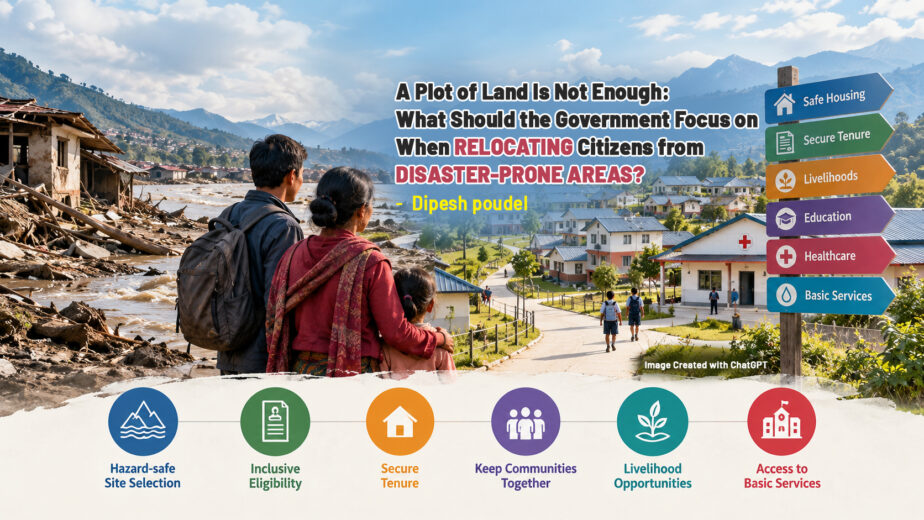
The flood that swept through Nepal on 26 August destroyed homes, infrastructure, and livelihoods. The government’s Rapid Damage and Needs Assessment estimates the damage at about $2.7 billion and says that 8,317 households were affected. For families whose homes stood along riverbanks that are now unstable, rebuilding where they lived may no longer be possible. The government may therefore have to relocate affected families, potentially making this the largest relocation Nepal has ever undertaken.
Relocating people is a problem Nepal has faced before, though never on this scale. After the 1993 Bagmati Basin Flood, many families returned to disaster-prone areas or were reluctant to remain in their new settlements. After the 2015 earthquake, residents of Singati village in Dolakha rebuilt houses in landslide-prone areas while waiting for the government to act on relocation plans. By the time authorities pursued relocation, residents were reluctant to leave because their livelihoods were tied to Singati, a major local market. The lesson is not that people refuse to leave dangerous places. It is that moving people is easier than giving them a reason to stay.
A successful relocation is much more than a safer plot of land and a new house; it is a viable place to live. Creating such a place begins with choosing the right site. Hazard mapping should come before site selection, so that new settlements are not placed in hazardous areas. After Typhoon Washi struck the Philippines in 2011, one study examined a resettlement site where 80 of 2,299 houses remained unoccupied because of their location, while landslides damaged another 37. An unsafe or unsuitable site can leave families vulnerable while wasting the resources invested in rebuilding.
The government must also decide who qualifies for relocation. Eligibility should depend on who was affected and what they lost. Evidence from previous resettlement programmes shows that informal settlers and landless labourers have often been excluded from compensation, where informal residents may receive little or no assistance even when a disaster destroys their homes. If Nepal ties relocation to formal ownership, it risks creating a new group of landless households. Families also need secure tenure if they are to build a life there. In Punjab, Pakistan, houses were transferred through agreements on stamp paper without formal registration, leaving residents uncertain about their ownership; one resident described it as feeling like living as a renter. Without secure ownership, families have less incentive to invest in their homes and may have difficulty using property as an economic asset or accessing credit. Nepal should therefore give relocated households formal, legally recognized title to their homes and land.
But a safe site and secure title will not keep families in a settlement if the move cuts them off from their livelihoods and social networks. People do not live in houses alone. They live among relatives, neighbours, markets, farms, schools and workplaces. Where feasible, relocation should keep whole settlements or neighbourhoods together and involve residents in choosing the new site and planning the move. In Punjab, Pakistan, a lottery separated families from relatives and from the riverside pasture on which they depended. Losing access to that pasture forced some families to sell their livestock at a loss, while separation from relatives disrupted the social networks they relied on. These losses pushed some families to leave their government-provided houses. Research across 14 relocations similarly found community-initiated moves to be the most consistent condition associated with good outcomes, while moving intact communities together also performed well.
Livelihoods equally determine whether families can remain in a new settlement. Two years after Typhoon Washi in the Philippines, 35 percent of surveyed households reported lower incomes than before the disaster. Evidence from Mozambique shows what can work. Families who received land, credit and agricultural support were less likely to report that their lives had worsened and were less likely to abandon their homes than families who received less targeted support. Nepal’s own experience shows why these matters. After the 2015 earthquake, families in Dolakha were reluctant to leave landslide-prone areas because they doubted that new locations could support their livelihoods. Relocation plans should therefore assess what work families can do at the new site and pair housing with skills training, access to credit and transport. Livelihood opportunities should also influence site selection: a safe site with no way to earn a living is unlikely to remain a permanent settlement.
Relocation should not stop at the provision of completed houses. Families need access to basic services. Health posts, safe water, electricity, roads and public transport must be available from the start. In Thailand, public transport failed to reach a new resettlement site, while pressure on the host village’s limited facilities created conflict. Nepal’s own experience in Tadi shows how this can be done differently. A water scheme built for relocated households also served the host community, helping ease tensions. The same principle should apply this time. New settlements should strengthen, rather than compete with, the services available to surrounding communities.
Taken together, a relocation succeeds when families stay because the new place works for them, not because they have nowhere else to go. That means a safe plot, secure tenure, a way to earn, schools and health services nearby, and neighbours they know. The decisions made in the coming months will determine whether relocation provides these families with the conditions they need to rebuild their lives.