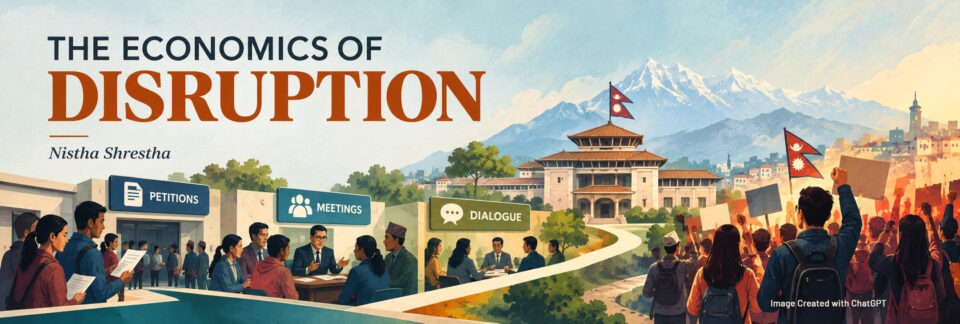
As a researcher, the rising number of protests worldwide makes me wonder why governments wait to react until citizens take disruptive measures. Citizens tend to begin by expressing grievances through petitions and other institutional channels in order to get a response from the government and have their problems addressed. This phenomenon has been well documented. A report called Discontent to Deliberation notes that Nepali citizens tend to begin by using formal institutional channels such as petitions, meetings, and asking for dialogues. But repeated delays or no response can escalate to sit-ins, road protests, and even confrontation. For example, in 2024, milk farmers with unpaid dues eventually spilled milk on the roads as a form of protest after their repeated meetings with government officials yielded no results. The same was also true for locals of Sundarbazzar protesting against the proposed construction of the Mid-Hill Highway in Lamjung.
It would be safe to say that obstructions and protests seem to garner the government’s attention in a way institutional channels are unable to. This pattern teaches citizens something about what it takes for them to be heard. This learning is deep-rooted in how Nepal’s formal channels of engagement came into existence and how governance has been taking shape at different levels. It also raises a question about the institutions through which citizens are expected to make themselves heard, and which level of government is responsible for responding to them. In Nepal, this question is particularly important because the country has moved from a highly centralised system to one in which decision-making is distributed across federal, provincial, and local governments.
After struggling with a unitary system of governance and going through a 10-year Maoist civil war, Nepal introduced a federal system of governance, which was aimed at promoting local-level development. In a post-conflict society like ours, which is going through a continuous cycle of transformation, federalism sought to bring governance closer to citizens by distributing decision-making authority across different levels of the government. Nepal’s democratic reforms slowly opened avenues for citizen participation in policy-making and for demanding change, giving citizens different formal channels to engage with the government. This flexibility from federalism would allow us to treat this process as a competition, potentially making it more effective. Although participatory mechanisms have been put in place, their effectiveness in generating a meaningful government response might vary. The question, then, is whether these channels allow citizens to receive a meaningful response before their grievances escalate.
This is where the role of local governments becomes important. With federalism come governments at different levels. The local governments’ biggest strength is that they have the required local context, such as the history, the actors engaged in the dispute, and the stakes involved, allowing them to resolve issues more accurately and faster. This allows them to formulate policies and responses for their jurisdiction instead of copying the policies released from the central government. Along with that, the local governments also face pressure to not let the citizens in their jurisdiction escalate to the central level. Local governments compete with each other to garner citizen trust and maintain their reputation. But proximity to citizens does not automatically make government responsive. Federalism creates more avenues for engagement, but it does not make the government immune to escalation.
A recent paper, Persistent Protests, provides an economic way of thinking about the interaction between the government and its citizens, where both parties bear costs from engaging in this back-and-forth. As protests persist, the costs also accumulate, meaning the government finally responding after protests could be driven by rising costs instead of the legitimacy of citizen’s grievances. On a case-by-case basis, the actual reason behind the government’s response might vary, but the larger pattern suggests government responding to disruptive behaviour. Such an observation might lead citizens to perceive protests as a necessary and effective channel of communication.
The Gen Z protest in September 2025 was a recent example of escalation. Following the government’s ban of 26 social media platforms, amid broader anger about political corruption, unemployment, and economic inequality, citizens mobilized to confront the government, bringing grievances about governance and demands for accountability into the protest. But the measures taken by the security forces during the protest intensified the confrontations. The government’s handling of the situation further amplified the crisis and weakened its credibility. The government’s responsiveness to highly disruptive protests could signal to citizens that escalation is necessary for their voice to be heard.
If this pattern is repeated, it can create a feedback loop. Citizens could observe that escalation can be a way to get a meaningful response from the government, increasing the perceived returns from such actions. This understanding could result in a loss of confidence in the institutional channels, weakening their effectiveness. It would further pose a greater risk of protests and confrontation becoming more common forms of engagement with the government.
Establishing different mechanisms or channels alone is not enough. The government also needs to respond meaningfully through these channels. Meaningful response can be measured through the time taken to respond, implementation of responses, and whether there is a way for citizens to follow up on them. Economically, earlier responsiveness from local government, given their context knowledge and close proximity to the citizens, would be cheaper for both local government and citizens than waiting for a protest to begin or reach its peak stage. Existing governance mechanisms should not communicate violence and disruption as the most credible route to government attention. Since citizens are always observing, governments at all levels need to think about whether they are actually listening to citizens and what precedent their responses are setting. It is imperative that governments share their responses to grievances through institutional channels in a timely manner rather than waiting for disruption.